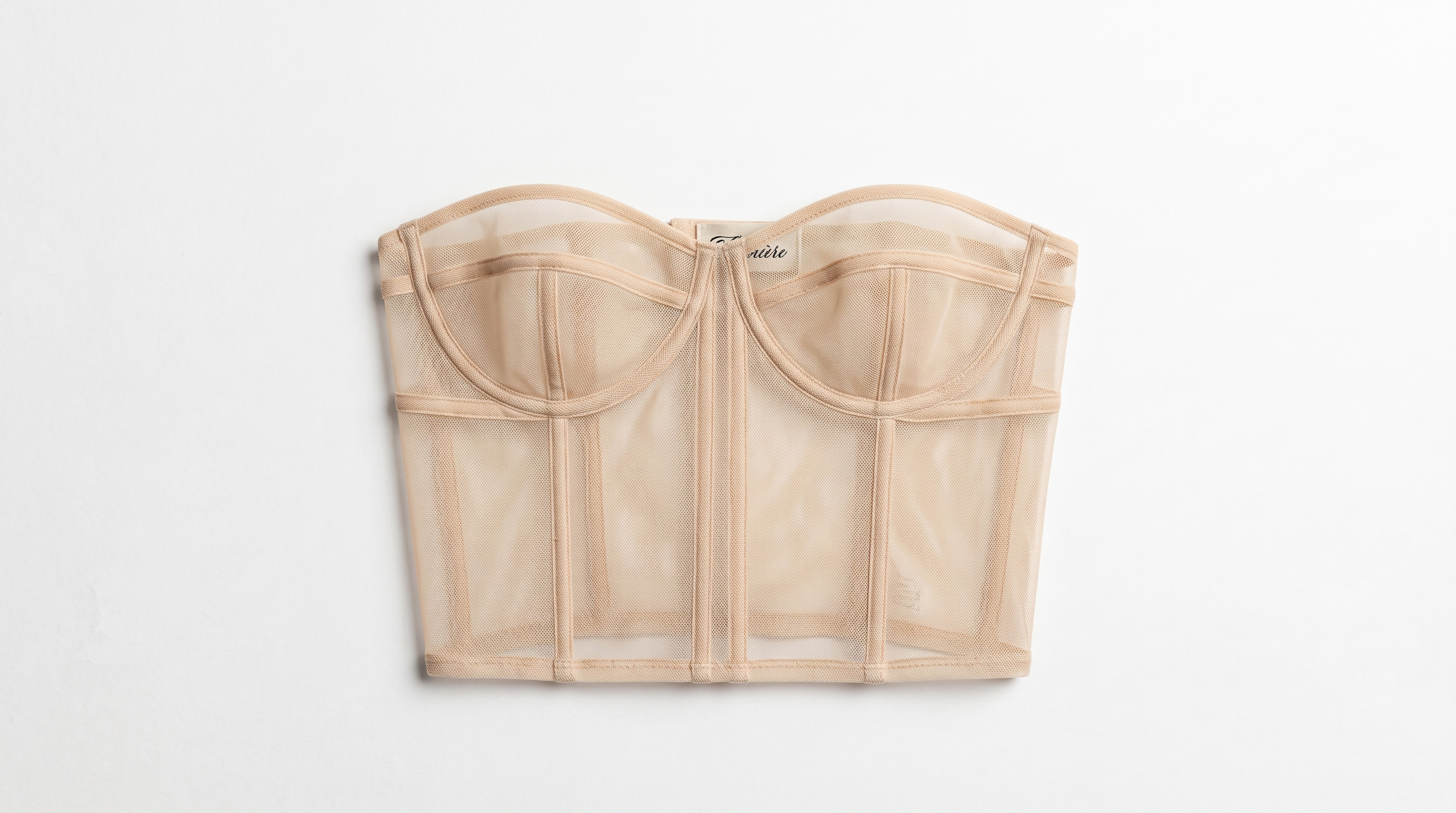
Ask what makes a corset hold and most answers say boning. Boning matters, but it is doing a smaller job than people assume. The pattern is doing the work.
Bones stop fabric from collapsing along their length. They do not create shape. Shape comes from cutting panels that are narrower at the waist and wider above and below, then seaming them together so the flat pieces become a three-dimensional curve. The bones sit in the seams and hold that curve rigid.
Get the panels wrong and no amount of steel will fix it. Get the panels right and you need fewer bones than you would think.
The panel pattern
A structured corset is typically six to twelve panels per side. More panels mean more seams, more control over the curve, and more cost.
Fewer panels give a smoother surface and a softer shape. Right for a decorative bodice or a corset-inspired top.
More panels give a stronger waist reduction and a more sculpted line, because each seam is another place to remove or add width. This is where real corsetry lives.
The seams are load-bearing. On a piece designed to reduce the waist, they carry serious tension and they need a proper stitch, a strong thread and often a flat-felled or bound finish rather than a simple overlock.
Boning
Three types, and they are not interchangeable.
Spiral steel coils like a spring. It flexes in every direction, so it follows a body curve without buckling. It goes in the curved seams over the hip and the bust. This is what makes a corset wearable rather than a cylinder.
Flat steel flexes in one direction only and resists in the other. It goes where you want rigidity: at the centre front, beside the closure, at the centre back beside the lacing. It stops the opening edge from bowing.
Plastic, usually polyester or acetate. Light, cheap, and it takes a permanent bend from body heat over time. Correct for a soft bodice or a garment worn occasionally. Not correct for anything asked to hold real tension, and it is the most common reason a piece that looked right in the sample looks wrong after a season in a customer's wardrobe.
Bones need casings, either a separate channel tape or the seam allowance itself stitched down. The bone must be shorter than the casing by a few millimetres and it must be tipped, or the end will work through the fabric.
The layers
A structured corset is usually three layers and each has a job.
Fashion fabric on the outside. This can be almost anything, because it is not doing structural work.
Strength layer in the middle. Coutil is the traditional choice: a densely woven cotton with a herringbone structure that resists stretching in every direction. A heavy twill or canvas can substitute. This layer is what stops the corset from growing under tension, and it is the layer most often omitted to save cost.
Lining against the body, smooth and washable.
A piece made without the strength layer will feel right when new and will stretch out, because the fashion fabric is carrying a load it was not woven for.
Closures
Busk at the centre front: two steel strips, one with loops, one with posts. Lets the wearer open the piece without unlacing. Requires accurate placement or it will gap.
Lacing at the centre back through grommets. Grommets need a reinforced panel behind them, usually a double layer plus a flat bone on each side of the lacing, or they will pull out. This is a common failure point and it is entirely preventable at the pattern stage.
Zip. Faster and cheaper, and it limits adjustability. Fine on a fashion piece, and it needs a bone beside it or the zip will bow.
What to check on a sample
Lace it or fasten it fully and look at the seams. Any puckering at a seam means the panel curve and the bone are fighting.
Check the waist tape. A structured piece should have a non-stretch tape at the waistline, stitched to the seam allowances, taking the tension so the fabric does not. Its absence is the difference between a corset and a decorated top.
Sit down in it. The most useful test and the one skipped most often. The bottom edge over the hip is where a bad pattern digs in.
Check bone ends through the lining. You should not feel them.
Look at it after an hour on a form under tension. Any bowing at the closure edges tells you the flat steel is missing or too short.
Where the cost goes
Corsetry is pattern-intensive and labour-intensive, and neither gets cheaper at volume the way a simple garment does. The panel pattern takes real development time, and a first fitting is rarely the last.
That development is the product. A brand that budgets for two rounds of fitting on a structured piece is usually planning for three.
Tirarin is a corsetry manufacturer making boned corsets, lingerie and shapewear, with structure built into the garment rather than added at the finish.